Celluloid Records
French/American label known for eclectic, ground-breaking 1980s releases.

Celluloid Records was a French/American record label founded by Jean Georgakarakos (sometimes shortened to Jean Karakos) and operated from 1976 to 1989 in New York City. The label produced a series of eclectic and ground-breaking releases, particularly in the early to late 1980s, largely under the auspices of de facto in-house producer Bill Laswell.
- founded
- 1976
- ceased_operations
- 1989
- founder
- Jean Georgakarakos (Jean Karakos)
- headquarters
- New York City
- field
- Record label
- nationality
- French/American
- known_for
- Eclectic and ground-breaking releases, early hip-hop, no wave, avant-garde pop, African music
Lore & Background
Jean Georgakarakos had previously run a chain of record shops in France called Pop Shop, in cities such as Paris, Lyon, Grenoble and Aix-en-Provence. In 1967, he formed jazz record label BYG Records, which collapsed in the mid-1970s. Karakos also produced albums such as Sonny Sharrock's Monkie-Pockie Boo, and some Art Ensemble Of Chicago, Archie Shepp, Don Cherry, Magma and Gong material. Celluloid began by releasing American no wave and French avant-garde pop by artists such as Métal Urbain, Mathematiques Modernes, James Chance and Alan Vega. It also licensed tracks from other artists and labels, releasing tracks by Soft Cell, The Names, Cabaret Voltaire and Tuxedomoon among others. In the early eighties, Celluloid had a business relationship with Michael Zilkha and Michael Esteban's Ze Records; artists including Was (Not Was), Alan Vega, Suicide and Lydia Lunch released tracks on both labels, sometimes simultaneously.
Reader's Guide
Celluloid Records played a significant role in the 1980s avant-garde and early hip-hop scenes, largely through the production work of Bill Laswell. The label's 1982 catalogue expanded to encompass early hip-hop artists such as Afrika Bambaataa, Fab 5 Freddy, Grand Mixer DXT, and Phase II, recorded at Martin Bisi's studio O.A.O. in Brooklyn. Laswell also produced Celluloid albums by Massacre and his own group Material, whose 1983 album One Down featured a young Whitney Houston. The label funded Laswell-related productions by Praxis, Time Zone, Shango, and even a resurrected Jimi Hendrix. Celluloid also released African music by Toure Kunda, Mandingo, Manu Dibango, and Fela Kuti. By 1986, increasing demands on Laswell's time meant his work for Celluloid became more sporadic, though he did produce Horses & Trees for Ginger Baker. The label continued to release records without Laswell, including Eric Dolphy's Iron Man and John McLaughlin's Devotion. In 1989, Karakos returned to Paris and produced the lambada dance music group Kaoma, which became a worldwide hit. Karakos sold Celluloid in debt to John Matarazzo for a symbolic dollar, but after Matarazzo failed to repay the bank, the catalog was sold back to Karakos in 1994. As of 2023, Karakos Productions & Publishing has gained the rights to exploit the Celluloid NY catalogue.
Did You Know?
- Celluloid Records was founded by Jean Georgakarakos, who had previously run the French record shop chain Pop Shop and the jazz label BYG Records.
- Bill Laswell produced the Grammy-winning 'Rockit' for Herbie Hancock while also producing and playing on Celluloid albums.
- Material's 1983 album One Down featured a young Whitney Houston in her first registered song.
- Celluloid released a posthumous Jimi Hendrix track, 'Doriella Du Fontaine', with Lightnin' Rod.
The Birth of a New Medium
In 1877, Thomas Edison created the phonograph, the very first machine capable of capturing and replaying human sound. The original device etched grooves into thin sheets of tinfoil, producing a result that was little more than a mechanical novelty. Yet the public was captivated, and the invention generated enormous publicity. Edison and his laboratory capitalized on the patent and the buzz, but then pivoted their energies toward commercializing electric lighting, stepping away from phonograph development for roughly a decade. During that hiatus, the earliest machines found a niche with itinerant showmen who traveled from town to town, renting halls to give educational demonstrations and charge admission. These tinfoil-based devices were too fragile and unreliable for any sustained practical use, and public enthusiasm gradually faded. The phonograph existed in this period as a fascinating curiosity rather than a viable product, waiting for the technological refinements that would eventually transform it into the foundation of an entirely new entertainment industry.
From Nickelodeons to Living Rooms
When Edison returned his focus to the phonograph in 1887, the following year brought the Perfected Phonograph and the establishment of the Edison Phonograph Company. The new format—wax cylinders roughly four and a quarter inches long and two and a quarter inches in diameter—became the de facto industry standard, offering about three minutes of playback at 120 revolutions per minute. The first commercially available entertainment cylinder, the Fifth Regiment March performed by Issler's Orchestra, appeared in 1889. At that stage, the only buyers were operators of coin-operated machines placed in saloons, amusement arcades, and other public venues. The machines themselves were prohibitively expensive, equivalent to several months of a worker's salary, and relied on cumbersome wet-cell batteries for power. The true turning point came in 1895, when affordable spring-motor phonographs designed for domestic use hit the market. That shift unlocked the potential for a mass consumer recording industry, moving the medium from a public spectacle into private homes.
Engineering the Modern Cylinder
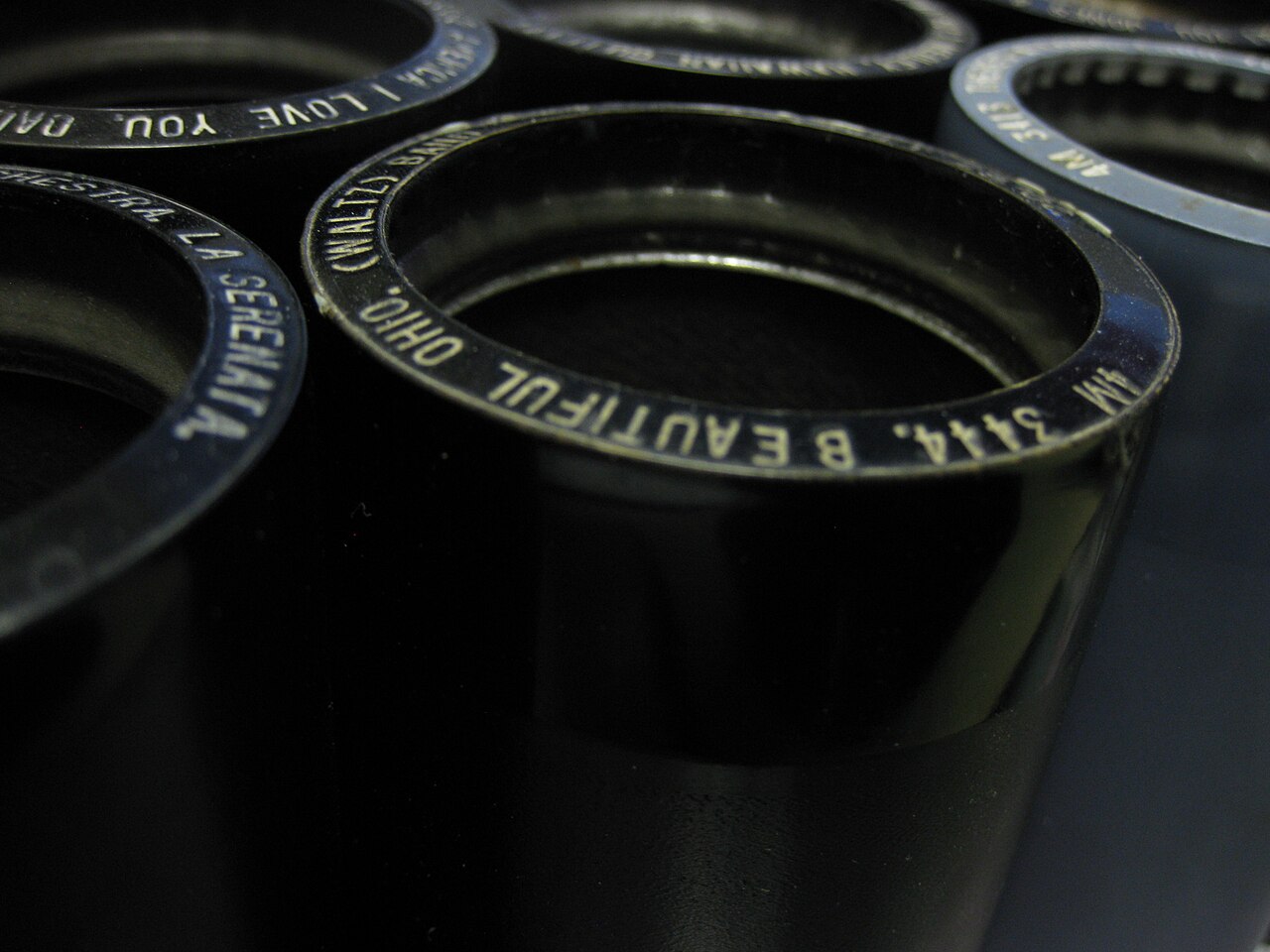
A critical breakthrough at Edison's laboratories was the development of a molding process that allowed pre-recorded cylinders to be mass-produced. By using slightly tapered forms and a material that shrank as it hardened, the company could stamp out identical copies at scale. In practice, however, regional distributors continued to fill the modest early demand through small-batch mechanical duplication, and molding did not become a major commercial force until the late 1890s. The cylinder format itself evolved rapidly: the 1902 Gold Moulded Records, made from a hard black compound, could endure hundreds of playings and ran at 160 RPM for greater loudness. In 1908, the Amberol line doubled the playing time to four minutes by tightening groove spacing, requiring new machines or retrofit attachments. By November 1912, Blue Amberol cylinders—molded from a smooth, hard plastic akin to celluloid—represented the latest iteration. Edison also made notable cultural contributions, including early recordings of the African-American group the Unique Quartet.
A Pioneer's Long Arc
The Edison recording enterprise grew from a single inventor's workshop into one of the defining companies of the early sound industry. The National Phonograph Company, manufacturing from 1896 onward, was reorganized as Thomas A. Edison, Inc. in 1911, reflecting the breadth of the business. For the first decade of commercial recording, cylinders carried no artist names at all—a practice that persisted until 1910. The company's New Jersey recording studio helped consolidate the American recording industry in the New York–New Jersey corridor, already the hub of the Tin Pan Alley sheet-music trade. Edison also pioneered the business-phonograph segment, producing the Ediphone for dictation and stenography, a line that eventually separated entirely from home entertainment machines. Yet by the 1920s, the company was falling behind competitors both in recording technology and in the popularity of its roster of performers. In 1929, Edison halted production of recordings altogether, closing a chapter that had spanned more than four decades of sound reproduction.
Gallery
Frequently Asked Questions
Who founded Celluloid Records and when did it open?
Jean Georgakarakos, a French-born figure often credited under the shorter name Jean Karakos, launched the label in 1976. It operated out of New York City and ran until 1989.
What kind of music did Celluloid Records put out?
The catalog is best described as eclectic and boundary-pushing, with its most celebrated output concentrated in the early-to-late 1980s. Releases spanned a wide range of experimental and genre-blending approaches rather than a single house sound.
Who was the key producer behind Celluloid Records releases?
Bill Laswell served as the de facto in-house producer, shaping the sonic direction of many of the label's most notable records throughout its active years.
Was Celluloid Records a French or American label?
It carried a dual French/American identity, rooted in founder Jean Georgakarakos's background, but was physically headquartered and operated from New York City.
Why do experimental-music fans still talk about Celluloid Records?
Because its relatively short 1976-to-1989 run produced a compact but influential body of ground-breaking recordings that helped define a particular slice of 1980s avant-garde and fusion music. Fans often cite it as a small label that punched well above its size in terms of artistic risk-taking.
More in Experimental music record labels 1-24
Spotted an error? Know more?
This is a living reference — every entry is fact-audited, and reader corrections feed straight into our audit queue. Suggest an edit · See this site's audit record